
Legal Process Outsourcing has been India’s quiet success story for two decades. While the world watched Indian IT services dominate global markets, a parallel revolution was happening in legal services. Today, Indian LPO firms handle billions of dollars worth of legal work for US, UK, Australian, and European law firms – from contract review to legal research, from discovery management to compliance support.
But 2025 brings a new competitive landscape. The advantages that made Indian LPOs dominant – cost arbitrage, English proficiency, large talent pool – are no longer sufficient. AI is automating routine legal work. Philippines and Vietnam are emerging as lower-cost alternatives. Western law firms are building their own offshore centers in India, bypassing LPO intermediaries.

To survive and thrive, Indian LPOs need to move up the value chain. Technology is the differentiator. But not just any technology – strategic technology deployment that enhances human expertise rather than replacing it, that creates defensible competitive advantages, and that allows small and mid-sized LPOs to compete against larger rivals.
This comprehensive guide explores exactly how Indian LPO firms can leverage technology to win and retain global clients in an increasingly competitive market.
Understanding the Shifting LPO Landscape
Before diving into technology strategies, let’s understand what’s changed and what it means for Indian LPOs.
The Old Model (2005-2020):
- Labor arbitrage was sufficient (India lawyers at $25-50/hour vs US lawyers at $300-500/hour)
- Volume work (document review, basic research) was the bread and butter
- Security was mostly about physical and network security
- Communication was primarily email and occasional calls
- Client acquisition was mostly through personal networks and conferences
The New Reality (2025):
- Clients expect sophisticated legal expertise, not just cost savings
- AI tools are automating 40-60% of traditional LPO tasks
- Data security and compliance (GDPR, DPDPA 2023) are non-negotiable
- Real-time collaboration and timezone-agnostic work is standard
- Digital presence and inbound marketing drive client acquisition
- Specialized expertise commands premium pricing
- Quality certification and process transparency are expected
The firms adapting to this new reality are growing 25-40% annually. Those clinging to the old model are seeing margins compress and clients leave.
Technology Strategy Framework for LPOs
Successful technology deployment for LPOs isn’t about having the latest tools. It’s about strategic choices that create competitive advantages. Here’s the framework:
1. Process Automation (Efficiency Layer) Automate repetitive tasks to reduce costs and increase throughput without compromising quality.
2. Quality Enhancement (Accuracy Layer) Use technology to improve output quality, reduce errors, and ensure consistency.
3. Security & Compliance (Trust Layer) Deploy security technologies to meet global data protection standards and client requirements.
4. Collaboration & Communication (Speed Layer) Enable real-time work across time zones with seamless client interaction.
5. Knowledge Management (Intelligence Layer) Build institutional knowledge systems that make your firm smarter over time.
6. Market Presence (Visibility Layer) Use digital technologies to attract clients globally without expensive physical presence.
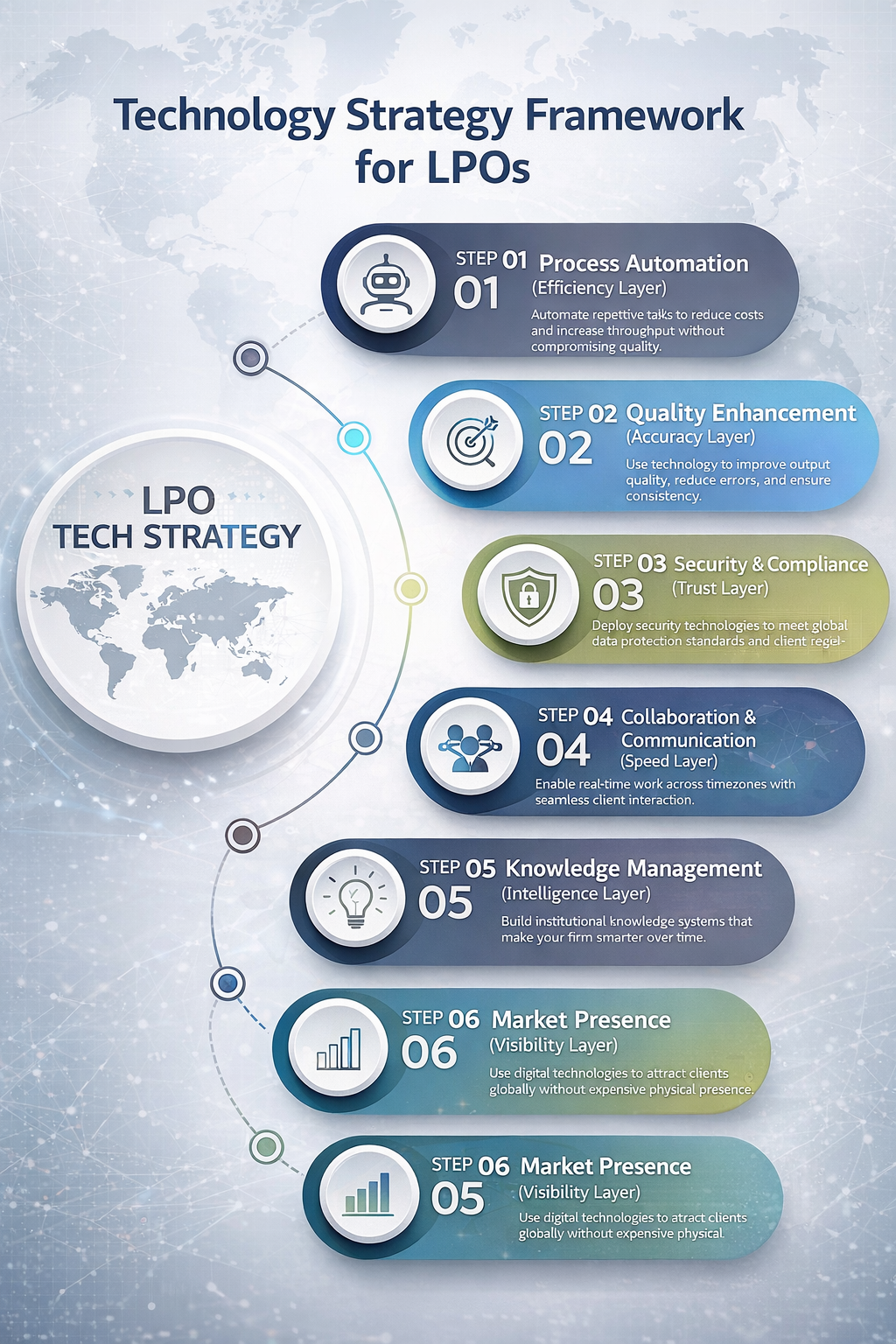
Let’s explore each layer with specific, actionable strategies.
Layer 1: Process Automation – Doing More with Less
Contract Analysis Automation: Tools like Kira, LawGeex, and eBrevia can extract key terms from thousands of contracts in hours instead of days. Indian LPOs should:
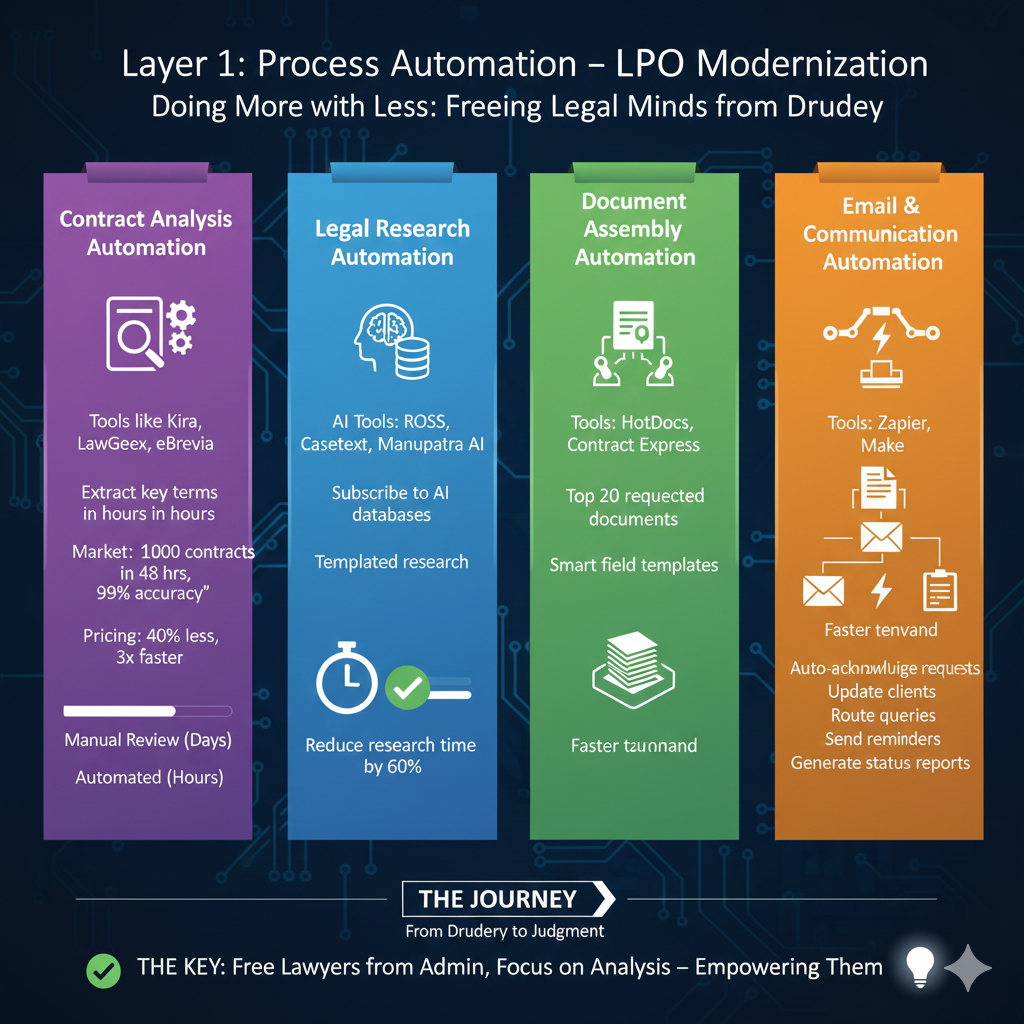
- Invest in one major contract analysis platform ($15,000-50,000 annually)
- Train teams to use it for initial extraction, then apply human judgment
- Market this capability: “We can review 1000 contracts in 48 hours with 99% accuracy.”
- Pricing model: Charge 40% less than manual review but deliver 3x faster
Legal Research Automation: AI tools like ROSS Intelligence, Casetext, and Indian platforms like Manupatra AI can accelerate research. Strategy:
- Subscribe to AI-enhanced legal research databases
- Create templated research methodologies
- Build jurisdiction-specific research protocols
- Reduce research time by 60% while improving comprehensiveness
Document Assembly Automation: Tools like HotDocs, Contract Express, or custom solutions can generate documents from templates. Implementation:
- Identify your top 20 most-requested documents (NDAs, employment agreements, etc.)
- Build high-quality templates with smart fields
- Create playbooks for customization
- Deliver faster turnaround than traditional drafting
Email and Communication Automation: Use tools like Zapier, Make, or custom scripts to:
- Auto-acknowledge client requests
- Update clients on milestone progress
- Route queries to appropriate teams
- Send deadline reminders
- Generate status reports
This isn’t about replacing lawyers – it’s about freeing them from administrative drudgery to focus on analysis and judgment.
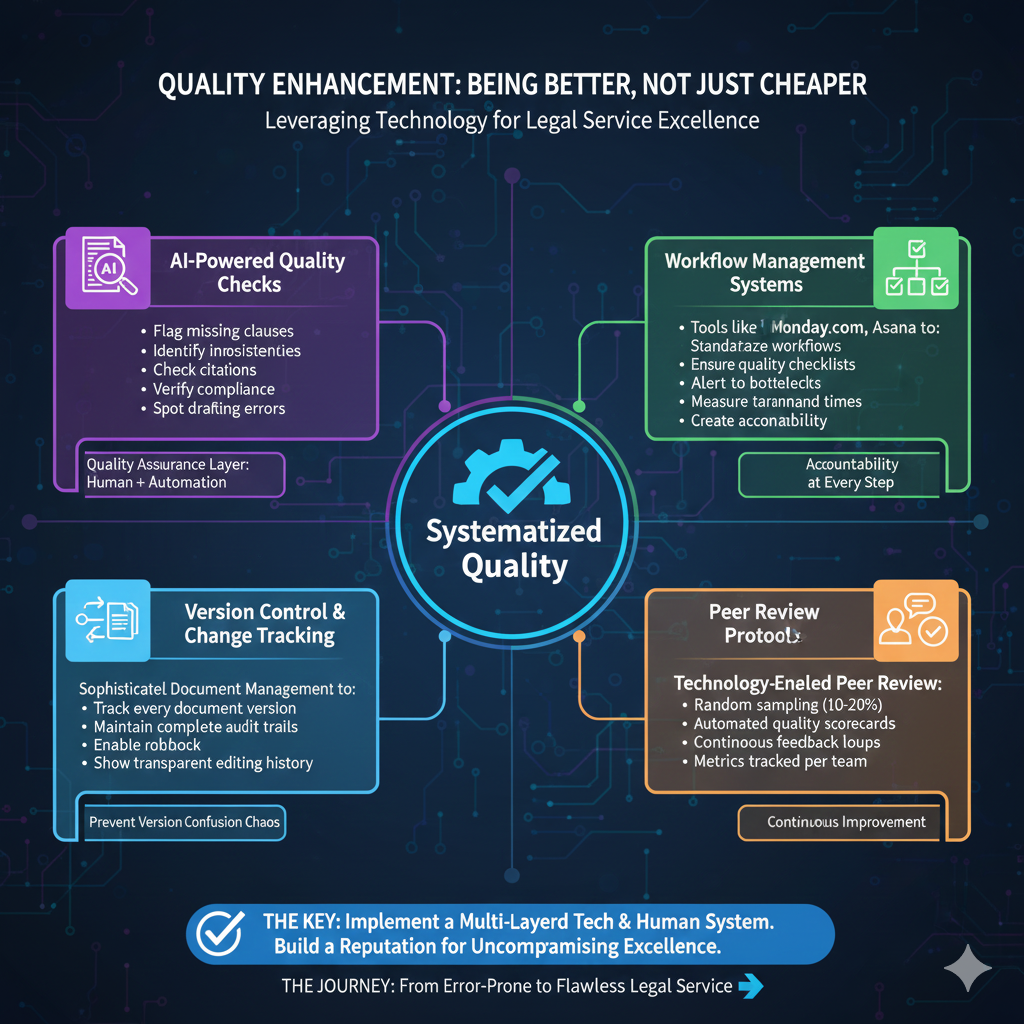
Layer 2: Quality Enhancement – Being Better, Not Just Cheaper
Quality is the new differentiator. Technology can help systematize quality.
AI-Powered Quality Checks: Tools like Kira, LexCheck, or custom NLP models can:
- Flag missing clauses in contracts
- Identify inconsistencies across documents
- Check citations in legal memoranda
- Verify compliance with client style guides
- Spot common drafting errors
Implement this as your “Quality Assurance Layer” before human review catches what automation might miss and automation catches what tired humans might overlook.
Version Control and Change Tracking: Use sophisticated document management (iManage, NetDocuments, or DMS platforms) to:
- Track every document version with automated naming
- Maintain complete audit trails
- Enable rollback to previous versions
- Show clients transparent editing history
- Prevent version confusion chaos
Workflow Management Systems: Tools like Monday.com, Asana, or legal-specific practice management software to:
- Standardize matter workflows
- Ensure every task follows quality checklists
- Alert supervisors to bottlenecks
- Measure turnaround times by matter type
- Create accountability at every step
Peer Review Protocols: Create technology-enabled peer review:
- Random sampling of 10-20% of work by senior lawyers
- Automated quality scorecards
- Continuous feedback loops
- Quality metrics tracked over time per team member
Layer 3: Security & Compliance – Meeting Global Standards
Security breaches can destroy an LPO’s reputation overnight. Compliance failures can result in massive legal liability. This isn’t optional.

Data Encryption:
- End-to-end encryption for all client data (at rest and in transit)
- Encrypted email services (ProtonMail, Virtru)
- Encrypted file sharing (Tresorit, Egnyte)
- VPN for all remote access
- Full disk encryption on all devices
Access Controls:
- Role-based access control (RBAC) – lawyers only see matters they’re assigned
- Multi-factor authentication (MFA) is mandatory for all systems
- Regular access audits and revocation of departed employees
- Principle of least privilege – minimum necessary access
Compliance Certifications:
- ISO 27001 (Information Security Management)
- SOC 2 Type II (Service Organization Controls)
- GDPR compliance for European clients
- DPDPA 2023 compliance for Indian operations
- Regular third-party security audits
These certifications cost $20,000-100,000 but they unlock enterprise clients who won’t work with uncertified vendors.
Secure Communication:
- Never use personal WhatsApp or Gmail for client matters
- Use approved collaboration platforms (Microsoft Teams, Slack with enterprise security)
- Maintain separate devices for work and personal use
- Implement DLP (Data Loss Prevention) tools
Privacy When Evaluating New Tools: When testing new legal tech platforms or collaboration tools, protect your organization’s primary communication channels. Use temporary email addresses for initial trials of software to avoid spam and potential data leaks. Once you’ve verified a platform’s legitimacy and security standards, then integrate it with your primary systems. This simple practice prevents your main inbox from being compromised while you evaluate dozens of potential solutions.
Layer 4: Collaboration & Communication – Working at the Speed of Global Business
Modern clients expect instant communication and real-time collaboration.
Timezone-Agnostic Work: Structure your operations for 24/7 coverage:
- Implement shift-based teams (if multiple locations)
- Clear handoff protocols between shifts
- Async communication tools (Loom for video updates, detailed Slack messages)
- Status dashboards that show real-time progress
Real-Time Collaboration Platforms:
- Microsoft 365 or Google Workspace for document co-editing
- Miro or Mural for visual collaboration
- Zoom/Teams for video calls with screen sharing
- Slack channels dedicated to specific clients or matters
Client Portal Technology: Give clients visibility into their matters:
- Custom client portals showing matter status
- Secure document upload/download
- Real-time milestone tracking
- Billing transparency and invoice access
- Chat functionality with their dedicated team
Project Management Transparency: Use tools like Asana, Monday, or legal PM software where clients can:
- See work breakdown structures
- Track progress in real-time
- Receive automated updates
- Provide feedback on deliverables
- Approve work at checkpoints
This transparency builds trust and reduces client anxiety about offshore work.
Layer 5: Knowledge Management – Building Institutional Intelligence
Your firm’s knowledge is its most valuable asset. Technology should capture, organize, and leverage it.
Searchable Knowledge Repositories:
- Central database of research memos (by jurisdiction, topic, date)
- Template library with version control
- Pleading bank of successful motions and briefs
- Contract clause library with explanations
- Regulatory updates and analysis
AI-Powered Knowledge Search: Implement tools that let lawyers search past work:
- “Find all memos we wrote on Indian data privacy in 2024”
- “Show contracts with force majeure clauses we drafted for tech companies”
- “What arguments worked in trademark opposition we filed?”
Continuous Learning Systems:
- Record and transcribe client calls for training (with permission)
- Create video tutorials on complex legal processes
- Build onboarding programs from past work
- Document lessons learned from every matter
Client Relationship Management: Use CRM systems (Salesforce, HubSpot, or legal CRMs) to:
- Track all client interactions and history
- Store contact details and decision-maker maps
- Record client preferences and requirements
- Schedule follow-ups and relationship touches
- Analyze client profitability and satisfaction
Layer 6: Market Presence – Being Discovered by Global Clients
The best technology and quality mean nothing if clients don’t find you. Digital presence is how small and mid-sized LPOs compete with giants.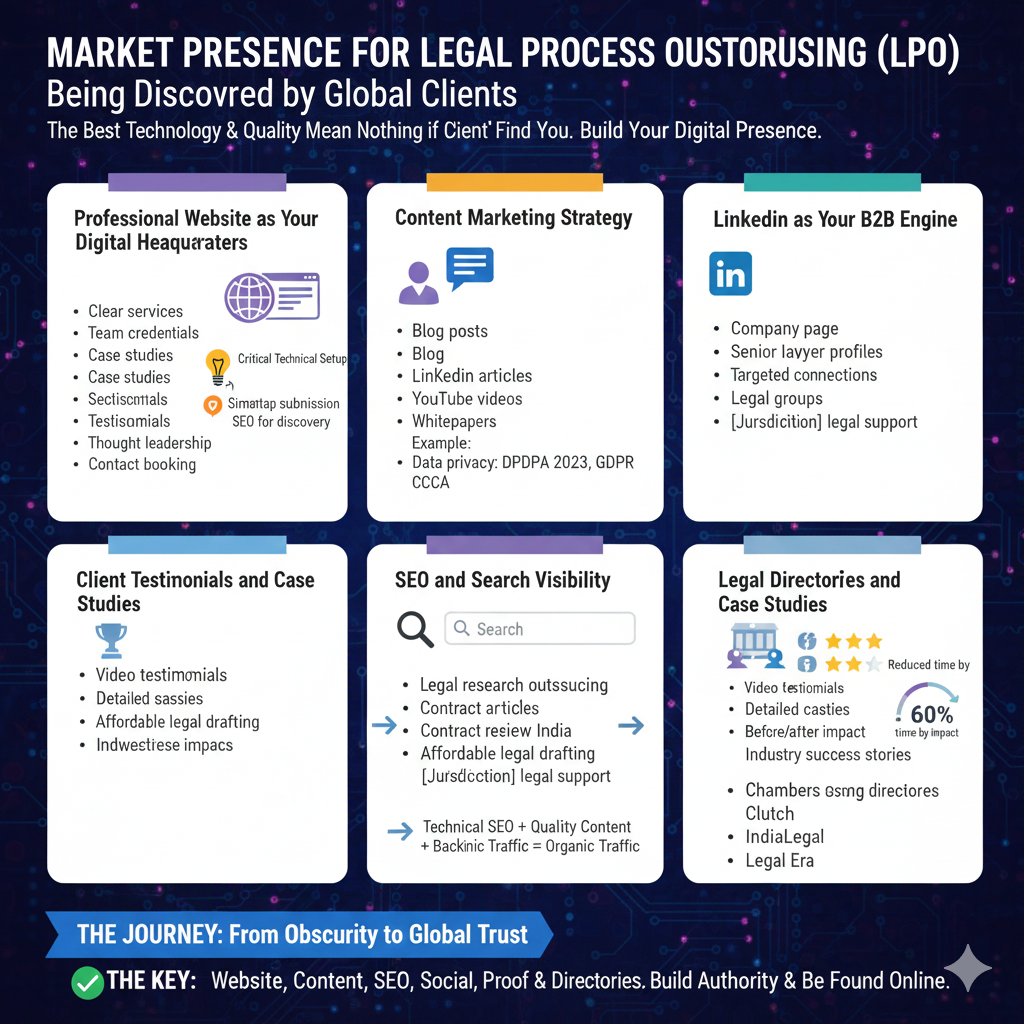
Professional Website as Your Digital Headquarters: Your website is your global office. It should include:
- Clear description of services and specializations
- Team credentials and expertise areas
- Case studies and success metrics
- Security certifications and compliance badges
- Client testimonials and results
- Thought leadership content (blog, whitepapers)
- Easy contact and consultation booking
Critical Technical Setup: When launching or updating your website, ensure it’s properly configured for search engines. Submit a sitemap to help Google, Bing, and other search engines index all your pages effectively. This is foundational SEO that many LPOs overlook, resulting in lost visibility when potential clients search for services you offer. Proper indexing ensures clients searching for “contract review LPO” or “legal research outsourcing India” can actually find your firm.
Content Marketing Strategy: Position your firm as thought leaders:
- Weekly blog posts on legal developments relevant to your practice areas
- LinkedIn articles analyzing regulatory changes
- YouTube videos explaining complex legal processes
- Webinars on topics like “Cross-border compliance” or “AI in legal due diligence”
- Whitepapers showcasing expertise
Example: If you specialize in data privacy work, publish detailed analysis of DPDPA 2023, GDPR updates, CCPA changes. Clients searching for these topics find you organically.
LinkedIn as Your B2B Engine: LinkedIn is where corporate counsel and law firm partners discover LPO providers:
- Company page with regular updates
- Individual profiles of senior lawyers with thought leadership posts
- Targeted connection requests to potential clients (not spam)
- Participate in legal groups and discussions
- Share insights, not promotional content
SEO and Search Visibility: Optimize for searches like:
- “Legal research outsourcing”
- “Contract review services India”
- “Affordable legal drafting LPO”
- “[Jurisdiction] legal support services”
- “Alternative legal services provider”
Technical SEO, quality content, and backlinks from legal directories drive organic traffic.
Client Testimonials and Case Studies: Nothing sells better than proven results:
- Video testimonials from satisfied clients (huge trust builder)
- Detailed case studies with metrics: “Reduced contract review time by 60% for Fortune 500 tech company”
- Before/after scenarios showing impact
- Industry-specific success stories
Legal Directories and Platforms: List your firm on:
- Chambers Associate directories
- Legal outsourcing directories
- LinkedIn Service Marketplace
- Clutch and similar B2B review platforms
- IndiaLegal, Legal Era and other Indian legal media
Technology Stack Recommendations by LPO Size
Small LPO (5-20 lawyers):
- Microsoft 365 or Google Workspace: $6-12 per user/month
- Basic practice management: Clio or similar ($50-80 per user/month)
- Communication: Slack or Teams (included with M365/Google)
- CRM: HubSpot free tier or Zoho CRM ($14 per user/month)
- Security: Bitdefender + VPN ($50/year per user)
- Total tech budget: $3,000-6,000/month
Mid-sized LPO (20-100 lawyers):
- Microsoft 365 E3 or Google Workspace Business Plus: $20-23 per user/month
- Advanced practice management: iManage + practice software ($100-150 per user/month)
- AI research tools: One major platform ($15,000-30,000/year)
- Contract analysis: Kira or similar ($25,000-50,000/year)
- CRM: Salesforce or HubSpot Professional ($45-80 per user/month)
- Security suite: Enterprise-grade EDR + SIEM ($30,000-60,000/year)
- ISO 27001 + SOC 2 compliance: $40,000-80,000/year
- Total tech budget: $25,000-60,000/month
Large LPO (100+ lawyers):
- Enterprise agreements with major vendors
- Custom software development for specialized workflows
- Dedicated IT security team
- Advanced AI and automation platforms
- Multiple offices with sophisticated infrastructure
- Total tech budget: $200,000-500,000/month
The key is scaling technology investment with revenue, not over-investing prematurely.
Building Your Technology Roadmap
Don’t try to implement everything at once. Here’s a phased approach:
Phase 1 (Months 1-3): Foundation
- Professional email and document collaboration
- Basic practice management software
- Secure communication channels
- Company website with service description
Phase 2 (Months 4-6): Quality & Security
- Workflow management systems
- Version control and document management
- Basic security certifications started
- Client portal implementation
Phase 3 (Months 7-12): Intelligence & Automation
- Knowledge management system deployed
- AI legal research tools adopted
- Process automation for repetitive tasks
- Advanced security certifications completed
Phase 4 (Year 2): Competitive Advantage
- Contract analysis automation
- Custom AI/ML models for specialized work
- Advanced analytics and reporting
- Strategic partnerships with legal tech vendors
Common Technology Mistakes LPOs Make
Mistake 1: Technology Without Training Buying expensive software that sits unused because teams weren’t properly trained. Solution: Budget 20% of technology cost for training and change management.
Mistake 2: Custom Building When Commercial Solutions Exist Spending $200,000 building a practice management system when $50/month per user commercial solutions exist. Solution: Buy before build unless truly unique requirements.
Mistake 3: Security as Afterthought Focusing on productivity tools but neglecting security until client demands it. Solution: Security should be foundational, not bolted on later.
Mistake 4: Technology Silos Purchasing disconnected tools that don’t integrate. Solution: Prioritize platforms with APIs and integrations. Microsoft/Google ecosystems integrate well internally.
Mistake 5: Over-Engineering Implementing enterprise-grade complex systems when simple tools would suffice. Solution: Match technology complexity to current organizational maturity.
Mistake 6: Ignoring User Experience Choosing tools based on features lists without considering whether lawyers will actually use them. Solution: Pilot programs with actual users before full deployment.
Creating Your Unique Technology Value Proposition
Technology alone doesn’t differentiate – strategic application does. Build your unique value proposition:
Specialization + Technology: “We’re the only LPO specializing in pharmaceutical IP with AI-powered patent analysis tools that reduce prior art search time by 70%.”
Speed + Quality: “Our automated contract analysis platform reviews NDAs in 2 hours with 99.5% accuracy, backed by human verification.”
Transparency + Control: “Clients access our project portal to see real-time progress, chat with teams directly, and approve deliverables at every milestone.”
Security + Compliance: “ISO 27001, SOC 2 Type II certified with dedicated infosec team and full GDPR compliance infrastructure.”
Your technology investments should ladder up to this differentiated positioning.
Measuring Technology ROI
Track these metrics to ensure technology investments are paying off:
Efficiency Metrics:
- Time saved per matter type (before vs after automation)
- Cases handled per lawyer (productivity improvement)
- Client query response time (communication tools impact)
Quality Metrics:
- Error rate reduction (quality tools impact)
- Client satisfaction scores (should improve with better tech)
- Rework percentage (should decrease)
Business Metrics:
- Client acquisition cost (digital marketing tools should reduce this)
- Client retention rate (should improve with better service)
- Revenue per lawyer (should increase with efficiency tools)
- Average deal size (should increase with premium positioning)
Security Metrics:
- Security incidents (should be near zero)
- Compliance audit pass rate
- Client security questionnaire pass rate
If technology isn’t improving these metrics, reevaluate your choices.
The Human Element: Technology Empowers, Doesn’t Replace
The biggest mistake is thinking technology replaces lawyers. The most successful LPOs use technology to augment human expertise:
- AI finds relevant cases → Lawyers analyze applicability
- Automation extracts contract terms → Lawyers assess risk and strategy
- Templates speed drafting → Lawyers customize for specific situations
- Tools flag issues → Lawyers apply judgment and recommend solutions
Clients don’t want robot lawyers. They want expert lawyers enhanced by technology delivering faster, better, cheaper results.
Conclusion: The Technology-Enabled LPO of Tomorrow
The Indian LPO industry stands at an inflection point. The firms that embrace strategic technology deployment will capture an increasingly sophisticated global legal market. Those that cling to pure labor arbitrage models will see margins compress and clients leave.
Technology is the equalizer. A 20-person LPO with the right tech stack and strategic focus can compete for and win clients that previously only worked with 500-person firms. A specialized boutique LPO can charge premium rates by offering AI-enhanced services that large generalist firms can’t match.
But technology is also an accelerator of strategy. If your strategy is weak – unclear positioning, poor quality, bad client service – technology will just help you fail faster. Get strategy right first, then deploy technology to execute that strategy brilliantly.
The playbook is clear:
- Specialize in high-value legal domains
- Deploy technology to deliver exceptional quality at competitive prices
- Build security and compliance into your foundation
- Create transparent client experiences through digital tools
- Market your expertise through digital channels
- Measure everything and iterate continuously
The global legal services market is huge and growing. Indian LPOs have inherent advantages – skilled workforce, strong legal education, English proficiency, cost efficiency, timezone coverage for US/Europe.
Add strategic technology deployment to those advantages, and you create an unbeatable value proposition for global clients.
The question isn’t whether technology will transform the LPO industry. It already has. The question is whether your firm will lead that transformation or be left behind by it.
Choose wisely. The future of your LPO depends on it.